
Contents
FTX, FTX US and Alameda research has filed for bankruptcy. Information indicates that a lot of money has been lost. It is unclear if investor funds will be returned. Do not deposit money to any money belonging to the FTX group.
You can find another more reliable crypto broker by visiting Investing.co.uk. You can also read my review of Binance, FTX main competitor. Binance seems to be solvent at the moment, but there is no guarantee that they are in better shape the FTX was before the fall.
The Rise, Collapse & Fallout of FTX (2019 – 2024+)
Chronological breakdown of Sam Bankman-Fried’s empire, the November 2022 bank run, criminal convictions, and creditor recoveries
Former Jane Street trader Sam Bankman-Fried (SBF) co-founds quantitative trading firm Alameda Research to exploit the Bitcoin “kimchi premium” between Japan and the US. In May 2019, SBF and Gary Wang launch the FTX exchange, advertising an institutional-grade matching engine, low collateral requirements, and the native utility token FTT.
FTX closes a $400 million Series C funding round at a $32 billion valuation backed by Sequoia Capital, Paradigm, Temasek, and Ontario Teachers’ Pension Plan. The firm secures a $135 million naming rights deal for the Miami Heat arena, runs Super Bowl ads featuring Larry David, and positions SBF as the regulatory-compliant, philanthropic face of digital assets in Washington, D.C.
When algorithmic stablecoin Terra-Luna collapses, crypto hedge funds (including Three Arrows Capital) default on billions in loans. Alameda incurs massive undisclosed trading losses. To shield Alameda from bankruptcy, SBF authorizes drawing on billions in customer deposits from FTX, facilitated by custom backdoors in FTX’s codebase that exempt Alameda from liquidation protocols. SBF publicizes himself as the “crypto lender of last resort,” offering bailouts to Voyager Digital and BlockFi.
CoinDesk publishes a leaked Alameda balance sheet showing the firm held $14.6 billion in assets, the vast majority of which consisted of unlocked and illiquid FTT tokens created out of thin air by sister company FTX. This reveals that Alameda’s solvency relies almost entirely on collateral it invented and controlled rather than independent assets.
Binance CEO Changpeng “CZ” Zhao announces Binance will liquidate its entire remaining holdings of FTT (approx. $530 million). Panic ensues as retail and institutional depositors rush to withdraw their capital. FTX processes over $6 billion in customer withdrawal requests in 72 hours before running out of liquid cash reserves and freezing withdrawals.
Binance signs a non-binding letter of intent (LOI) to acquire FTX.com to stem market contagion. Less than 24 hours later, after reviewing FTX’s internal books and noting reports of mishandled customer funds, Binance walks away. SBF frantically pitches Wall Street and sovereign wealth funds to plug an estimated $8 billion shortfall, but finds no takers.
FTX, FTX US, Alameda Research, and approximately 130 affiliated entities file for Chapter 11 bankruptcy in Delaware. SBF resigns, and veteran restructuring officer John J. Ray III (who previously oversaw the liquidation of Enron) is appointed CEO. Hours after the filing, unauthorized transactions siphon over $400 million out of FTX wallets into mysterious addresses.
Royal Bahamas Police arrest Bankman-Fried at his Nassau penthouse following an indictment by the US Attorney’s Office for the Southern District of New York (SDNY). Extradited to the US, he is released on a record $250 million bond. Key lieutenants—Alameda CEO Caroline Ellison and FTX CTO Gary Wang—plead guilty to federal fraud charges and agree to testify as cooperating witnesses.
Following a four-week federal trial featuring testimony from Ellison, Wang, and engineering head Nishad Singh, the Manhattan jury deliberates for under four hours. SBF is found guilty on all seven counts of wire fraud, securities fraud, commodities fraud, and money laundering conspiracy.
US District Judge Lewis Kaplan sentences Bankman-Fried to 25 years in prison and orders $11 billion in forfeiture. Kaplan highlights SBF’s perjury on the witness stand and total lack of remorse, describing his defense as “misleading, logically strained, and often outright untruthful.”
The Delaware Bankruptcy Court approves the Chapter 11 reorganization plan. Benefiting from the market recovery of Solana (SOL), Bitcoin, and Alameda’s early venture investment in AI firm Anthropic (sold for over $880 million), the estate amasses between $14.7 billion and $16.5 billion in distributable assets, enabling payouts of 118% to 142% of allowed petition-date dollar claims.

FTX is a cryptocurrency exchange owned by the company FTX. In early 2022, the exchange had over 1 million users.
The company FTX is incorporated in Antigua and Barbuda but headquartered in The Bahamas. The FTX Digital markets Ltd. unit is regulated by the Securities Commission of the Bahamas.
Examples of entities that have invested in FTX are Softbank, Sequoia Capital, Binance, Temasek, Paradigm, Ontario Teachers’ Pension Plan Board, NEA, IVP, Vision Fund 2, Lightspeed Venture Partners, Steadview Capital, Tiger Global, and Insight Partners. Binance divested their shares in 2o21.
FTX in the United States
For legal reasons, FTX operates a separate exchange for United States traders. The main FTX exchange does not service United States traders; they need to use the FTX.US exchange instead. The trading assortment at FTX US is smaller than at the main FTX exchange.
FTX and FTX US have overlapping management teams but separate capital structures.
FTX.US is a money services business registered with The Financial Crimes Enforcement Network (FinCEN) in the United States. FinCEN is a government bureau administered by the U.S. Department of the Treasury.
In October 2021, FTX US acquired LedgerX and rebranded it FTX US Derivatives. FTX US Derivatives is licensed as a Derivatives Clearing Organization, Swap Execution Facility and Designated Contract Market by the U.S. Commodity Futures Trading Commission (CFTC).
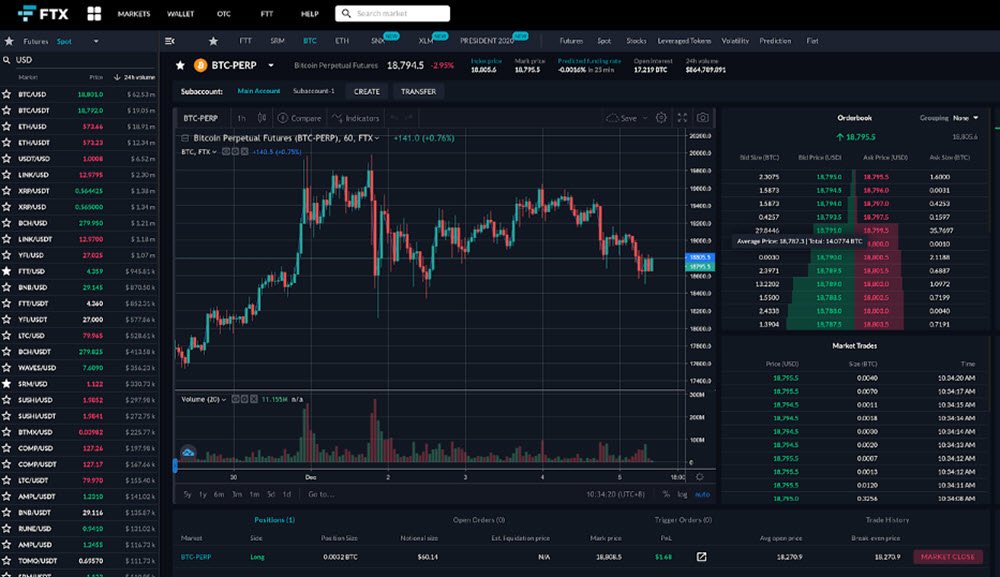
Key products of the FTX (outside the United States)
- Buying and selling cryptocurrency. Spot trading is available for over 300 different currency pairs. Examples of available pairs are BTC/USDT, XRP/USDT, ETH/USDT, and FTT/USDT.
- Derivative contracts involving cryptocurrency, including options, futures contracts and volatility products
- Leveraged trading
- NFT and collectable transactions
Short facts about the company FTX
Founded: 2019
Founders: Sam Bankman-Fried and Gary Wang
Headquarters: Nassau, The Bahamas
Website: ftx.com
Income: For the year 2021, the company FTX reported 1.02 billion USD in revenue and 388 million USD in net income.
The FTX cryptocurrency exchange
The platform
The FTX trading platform is available for desktop and in mobile apps. In addition to basic orders, more advanced orders can be used, such as trailing stop orders.
Currencies
There is support for around 300 cryptocurrencies and nine traditional currencies.
The nine traditional currencies are USD, EUR, GBP, AUD, CAD, CHF, ARS (Argentinian peso), BRL (Brazilian real), and GHS (Ghanaian cedi).
Important: Within certain limits, there is also support for certain other currencies, including the Turkish lira and the Japanese yen.
The FTX token
FTX has issued the cryptocurrency (“exchange token”) FTT. The initial release took place on May 5, 2019.
White paper: FTT Whitepaper.
FTX Ventures
FTX announced the $2 billion venture fund FTX Ventures in early 2022.
History
Foundation
FTX was founded in May 2019 by Sam Bankman-Fried and Gary Wang. Both are MIT graduates. Prior to founding FTX, Bankman-Fried worked as an ETF trader at Jane Street Capital.
Moving headquarters
FTX moved their headquarters from Hong Kong to The Bahamas in September 2021.
Examples of notable acquisitions
In August of the following year, FTX acquired the cryptocurrency portfolio tracking app Blockfolio for $150 million. In September 2022, FTX.US won the auction selling the digital assets of the bankrupt crypto brokerage Voyager Digital, a deal worth roughly $1.4 billion, including $1.3 billion in cryptocurrency.
Both deals fell through due to FTXs bankruptcy.
Misleading claims
In 2022, a tweet from FTX president Brett Harrison implied that FTX had FDIC insurance. The United States Federal Deposit Insurance Corporation (FDIC) responded with a cease-and-desist letter in August, which prompted Harrison to delete the tweet and Bankman-Fried to clarify in another tweet that FTX does not have FDIC insurance.